Gaskets are mechanical seals that sit between two pipe flanges. Their job is simple: create a leak-proof barrier to stop fluid or gas from escaping. While they seem simple, choosing the wrong gasket can cause leaks, safety hazards, and expensive downtime.
This guide explains the main types of flange gaskets to help you make a better choice.
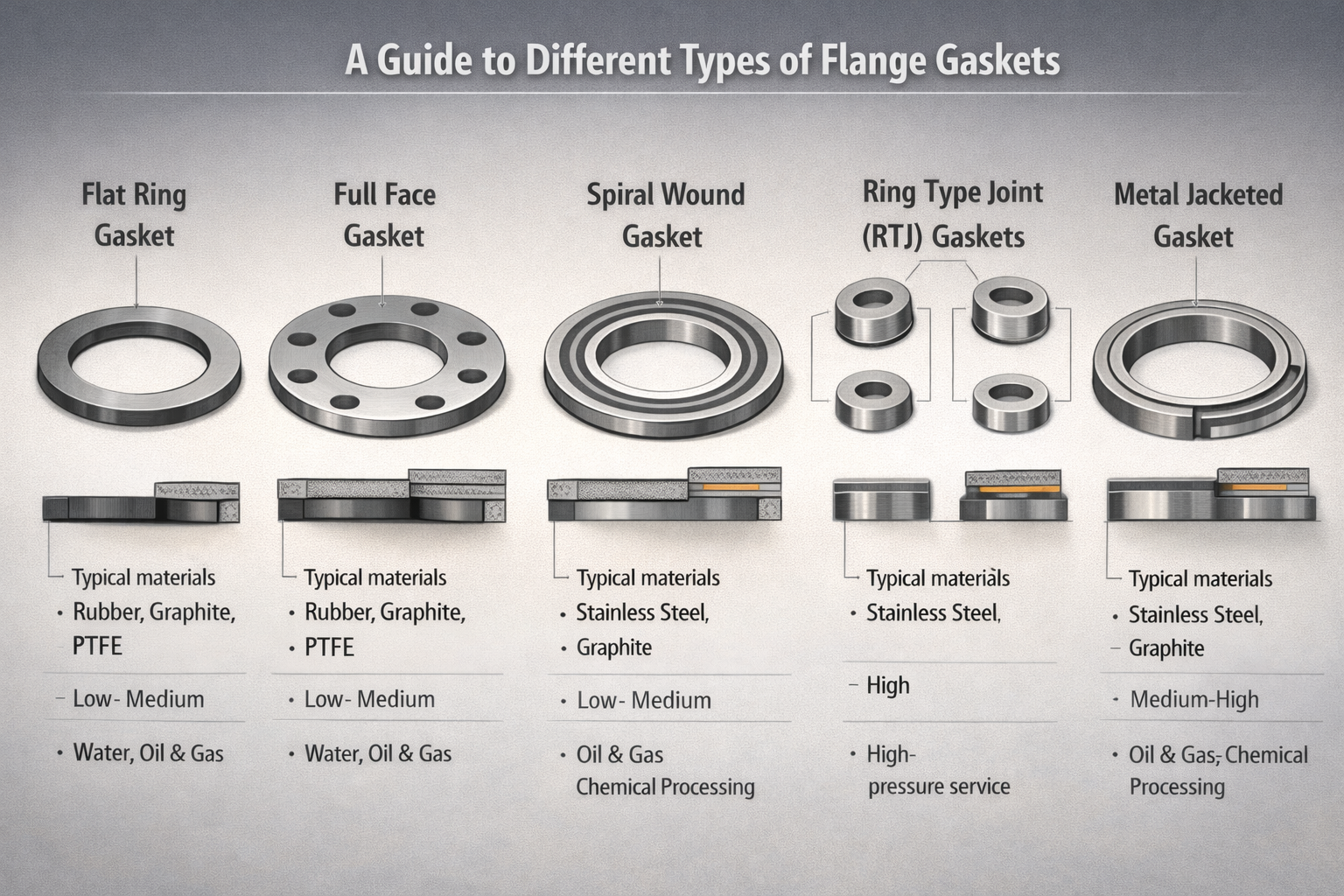
Three Main Categories of Gaskets
Flange gaskets are typically grouped by their construction: non-metallic (soft), metallic (hard), or semi-metallic (composite). The right category depends on your system’s pressure, temperature, and the fluid you are sealing.
This table gives you a quick overview of each category.
| Category | Main Materials | Pressure & Temp Suitability | Common Flange Faces | Key Characteristics |
| Non-Metallic (Soft) | Rubber, PTFE, Compressed Non-Asbestos Fibre (CNAF), Graphite | Low to Medium | Best for Flat Face (FF); can be used on Raised Face (RF) | Flexible, cost-effective, easy to cut and install. |
| Semi-Metallic (Composite) | Metal + filler (e.g., Graphite, PTFE) | Medium to Very High | Raised Face (RF), Tongue & Groove | Resilient, handles temperature/pressure cycles well. |
| Metallic (Hard) | Stainless Steel, Soft Iron, Monel | Very High | Ring-Type Joint (RTJ) | Very strong, minimal creep, for extreme conditions. |
A Closer Look at Common Gasket Types
Non-Metallic Gaskets
These are cut from sheet materials. They are versatile and good for many general applications.
- Rubber Gaskets: Made from elastomers like EPDM or Nitrile. They are used in low-pressure systems like water lines.
- PTFE Gaskets: Made from Teflon. They resist almost all chemicals.
- CNAF Gaskets: Made from compressed fibers like aramid or fiberglass bound with rubber. They are a common, general-purpose replacement for old asbestos gaskets.
Semi-Metallic Gaskets
These combine metal for strength with a soft filler for sealing.
- Spiral Wound Gaskets: The most common composite type. They have a V-shaped metal strip (like stainless steel) wound with a filler like graphite. They are excellent for high heat and pressure and handle system vibration well.
- Kammprofile Gaskets: They have a serrated metal core with a soft layer (like graphite) on top. They seal well on less-than-perfect flange surfaces and are used in high-temperature and high-pressure applications.
- Metal Jacketed Gaskets: A soft filler material is encased in a thin metal jacket (often stainless steel). They are often used in heat exchangers.
Metallic Gaskets
These are made entirely from metal and are used for the toughest jobs.
- Ring-Type Joint (RTJ) Gaskets: Precision-machined, solid metal rings (oval or octagonal) that fit into a special groove on the flange face. They are the standard for very high-pressure systems in oil and gas.
- Corrugated & Flat Metal Gaskets: Made from sheets of metal that are corrugated or flat. They need high bolt load to seal and are used in high-temperature steam or chemical services.
How to Select the Right Gasket
Choosing a gasket involves more than just size. You need to consider your operating conditions to ensure a safe, lasting seal.
- Fluid Type: The gasket material must not react with or degrade in the fluid. For example, use PTFE for strong acids. Sealing gases is often harder than sealing liquids.
- Temperature & Pressure: These are the most critical factors. A gasket that works at room temperature might fail at high heat. Always check the material’s ratings for both your operating and maximum test pressure.
- Flange Information: The gasket must match your specific flange. You need to know the Nominal Pipe Size (NPS), Pressure Class (150, 300, etc.), and Flange Face Type (RF, FF, RTJ). Mixing a Flat Face gasket with a Raised Face flange is a common installation error that leads to leaks.
- Standards: For industrial systems, gaskets and flanges must meet dimensional standards like ASME B16.5 (for the flange) and ASME B16.20 (for metallic gaskets) to ensure a proper, safe fit.
Selecting the correct gasket is a technical decision that balances performance, safety, and cost. Using a cheap gasket in the wrong application can lead to leaks, environmental issues, and much higher costs from unplanned shutdowns.
Need help navigating these choices for your specific application? Our team at Texas Flange can provide the technical guidance to ensure you get a reliable, leak-proof seal. Submit your project details for expert advice: http://texasflange.com/lp12/
FAQ: Common Questions About Gaskets
Q: Can I reuse an old gasket?
A: It’s not recommended. Gaskets compress permanently during installation to form the seal. A used gasket has already taken this “set” and will not seal properly a second time.
Q: What are fugitive emissions, and why do they matter?
A: Fugitive emissions are small, unintentional leaks of gas from piping connections. Stricter environmental laws now regulate these leaks, which can influence the type of gasket you are required to use.
Q: How can I tell if a gasket has failed?
A: Visible leaking is the obvious sign. Other causes of failure include incorrect bolt tightening, misaligned flanges, or using the wrong gasket material for the service conditions.
Q: What’s the difference between a “full-face” and a “ring” gasket?
A: A full-face gasket covers the entire flange surface, including the bolt holes. It is used with Flat Face (FF) flanges. A ring gasket sits inside the circle of bolts and is used with Raised Face (RF) flanges. Using the wrong type reduces the sealing area and can cause leaks.